Why Choose Large Scale Injection Molding for Your Production Needs?
In today’s competitive manufacturing landscape, companies face tough choices. Large Scale Injection Molding emerges as a viable solution for many production needs. This method offers efficiency and the ability to produce high-quality parts in large volumes. With advanced machinery and processes, it streamlines production timelines.
Furthermore, the impact of material costs plays a crucial role. Large Scale Injection Molding can help companies balance cost and quality. The upfront investment might seem daunting. However, the long-term savings and benefits often outweigh the initial costs. Ensuring consistency in product output might become challenging at this scale. Businesses must reflect on their specific needs and capabilities.
Ultimately, the decision to choose Large Scale Injection Molding should be careful. It’s not just about volume; factors like precision and material choice matter too. Companies should ask tough questions about their production goals. Each project has its unique demands and dimensions. Selecting this method might lead to transformative changes in their operations.
Benefits of Large Scale Injection Molding for Manufacturing
Large scale injection molding is gaining traction in the manufacturing sector. With the ability to produce high volumes of complex parts quickly, it enhances efficiency and reduces costs. According to industry reports, companies using large scale injection molding can achieve production rates of up to 400 units per hour. This efficiency can dramatically lower the cost per part.
One remarkable benefit is material versatility. Manufacturers can choose from a wide range of thermoplastics and thermosets. This ensures that products meet specific performance requirements. The flexibility in material choice leads to higher quality and durability. Notably, 70% of companies reported improved product consistency when employing this method.
Tip: Consider automating your quality control processes. This can enhance overall production quality. It is essential to ensure that molds remain in top condition. Even the smallest imperfection can lead to significant production downtime.
Another advantage is reduced labor costs. As machinery handles repetitive tasks, human error decreases. Reports indicate a 30% decline in labor dependency when switching to large scale injection molding. However, reliance on machines can pose risks. It may lead to complacency in monitoring quality and efficiency. Balancing automation with skilled oversight is critical.
Cost Efficiency in Large Scale Injection Molding Processes
Large scale injection molding is a popular choice for manufacturers aiming to reduce production costs.
It allows companies to produce items in high volumes while maintaining quality. One of the key benefits is the
decrease in per-unit costs. As production increases, the
cost of materials, labor, and overhead often goes down. This efficiency is vital for competitive markets.
In addition to cost savings, large scale injection molding streamlines the production process.
Automated systems can handle repetitive tasks, which speeds up assembly. This reduces the likelihood of
human error but may require careful oversight. It's important to monitor quality at every stage.
A slight miscalculation can lead to waste.
Tips for success include investing in quality molds. A well-designed mold lasts longer and performs better.
This minimizes delays and unexpected costs. Regular maintenance of machinery is essential. Broken machines can halt production and increase expenses.
Always keep an eye on the process flow. Avoid complacency; small issues can become big problems if left unchecked.
Versatility of Materials in Large Scale Injection Molding
Large scale injection molding offers remarkable versatility in material choices. This flexibility allows manufacturers to select from a wide array of polymers, metals, and composites.
According to a 2022 industry report, over 75% of products created using injection molding utilize thermoplastics. These materials are favored for their durability and adaptability.
In addition to thermoplastics, manufacturers increasingly use bio-based materials. A survey conducted by the Molding Association noted that 30% of companies are exploring sustainable materials for production. This shift highlights a growing awareness and willingness to adapt to eco-friendly options. However, challenges remain, such as the cost and availability of these materials.
The ability to switch materials also brings a level of complexity. Not all materials work well with existing machinery and processes. This may require additional investment in equipment or re-training for the workforce. Companies often face difficulties in maintaining quality across different materials. As production scales, the choice of materials can significantly impact both performance and costs. Balancing these factors demands careful planning and execution.
Speed and Production Rate Advantages in Large Scale Molding
Large scale injection molding offers significant speed and production rate benefits. The efficiency of this manufacturing process can lead to reduced cycle times, sometimes as low as 10 seconds per part. According to a recent industry report, companies adopting large scale molding techniques have seen increases in output by up to 30%. This dramatic surge in productivity can meet the demands of mass production effectively.
One key aspect is the ability to produce complex designs quickly. Complex parts, typically challenging to manufacture, can become viable with large scale injection molding. The process enables the duplication of intricate designs while maintaining high precision. Additionally, the use of multi-cavity molds can significantly elevate production rates. However, there is a notable upfront cost for mold creation that requires careful financial consideration.
Quality control remains a critical component. While the speed of production is impressive, maintaining consistent product quality can be challenging. Variations in temperature and pressure during injection can result in defects. Continuous monitoring and adjustments are essential to manage these risks. Achieving the right balance between speed and quality requires ongoing evaluation and adaptation. This complex dynamic underscores the need for skilled operators in the industry.
Production Rate Comparison: Large Scale Injection Molding vs. Traditional Methods
Quality Control and Consistency in Large Scale Injection Molding
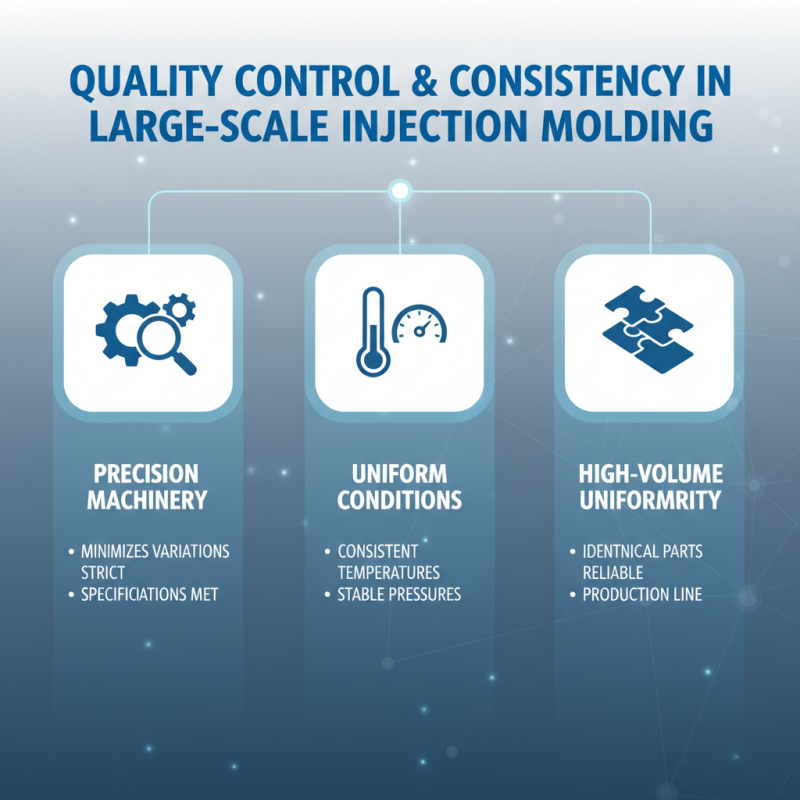
Large scale injection molding offers significant advantages in quality control and consistency. This process utilizes advanced machinery to produce parts in large quantities. The precision of these machines minimizes variations, ensuring that each piece meets strict specifications. With consistent temperatures and pressures, the results are often uniform, which is essential for any production line.
However, achieving this level of consistency can be challenging. Smaller batches may suffer from quality issues that large-scale production can mask. Sometimes, minor defects go unnoticed in a vast output. Regular maintenance of machines is crucial, as wear can lead to unexpected changes in quality. Monitoring should be proactive, with routine checks to avoid issues before they affect the end product.
In addition, training operators is vital for maintaining quality. Skilled personnel can identify problems early on. They play a key role in fine-tuning processes, making adjustments as needed. Yet, even the best training cannot eliminate all risks. There may be days when production falls short of expectations. Reflecting on these challenges is essential for continuous improvement in large scale injection molding.